

Rajkumar Oli,
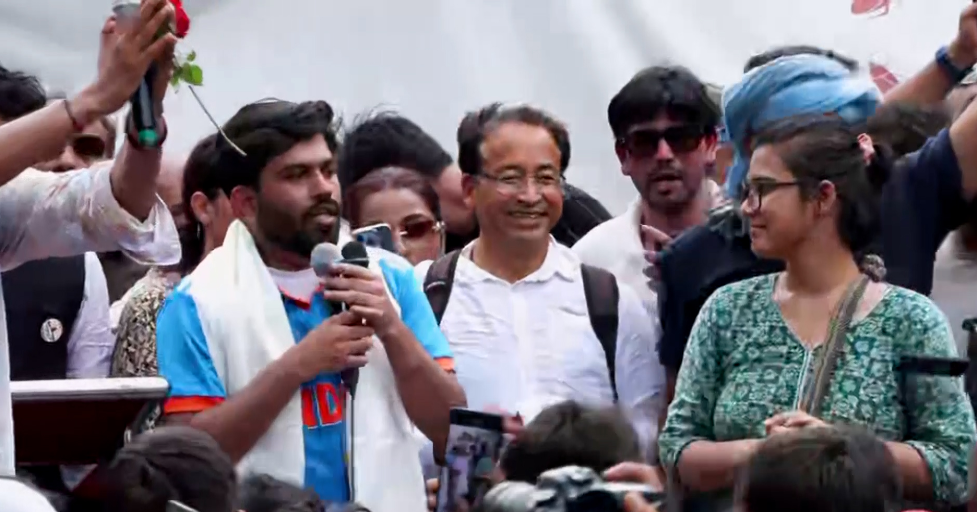
Kathmandu, June 6: A protest that began over allegations of examination irregularities has rapidly evolved into a broader conversation about accountability, transparency, and public trust in India’s education system. On Saturday, thousands of demonstrators gathered at New Delhi’s Jantar Mantar under the banner of the emerging “Cockroach Janata Party” (CJP), demanding action over the alleged NEET-UG 2026 paper leak and reported irregularities in the CBSE Online Scoring Mechanism (OSM).
The protest, which called for the resignation of Union Education Minister Dharmendra Pradhan, has attracted national attention not only because of the issues involved but also because of the personalities associated with it. CJP founder Abhijeet Deepke reportedly traveled from Boston to lead the demonstration, while the presence of renowned education reformer and social activist Sonam Wangchuk added moral and symbolic weight to the movement.
Although the long-term significance of the protest remains uncertain, it has already raised an important question: Is India witnessing the emergence of a new youth-driven movement capable of reshaping public discourse, or is this merely a temporary expression of frustration?
Beyond a Protest: A Crisis of Trust
Education occupies a unique place in Indian society. For millions of families, competitive examinations are not simply academic assessments; they are gateways to social mobility, economic security, and professional success.
When allegations of paper leaks, manipulation, or unfair evaluation emerge, the consequences extend far beyond examination halls. They undermine confidence in institutions and create a perception that merit and hard work are being compromised.
The NEET examination is one of the most competitive entrance tests in the world, with millions of students competing for a limited number of medical seats. Any suggestion of irregularity naturally provokes strong reactions from students, parents, and educators alike.
What makes the current situation particularly significant is that it taps into a growing sentiment among young people who increasingly demand transparency, fairness, and accountability from public institutions.
Why the Government May Be Paying Attention
Prime Minister Narendra Modi’s government has built much of its political appeal around aspirations of development, innovation, and opportunity. Young voters have played a crucial role in shaping this political narrative.
However, issues such as unemployment, recruitment delays, examination controversies, and educational inequities have also become recurring concerns. While the government remains politically strong, movements centered on youth aspirations can be difficult to ignore because they touch directly upon the future of a generation.
The concern for policymakers may not necessarily be the organizational strength of the Cockroach Janata Party itself. Rather, it may be the broader public dissatisfaction that the movement appears to represent.
History demonstrates that governments often face greater challenges from widespread public sentiment than from individual organizations. If a movement succeeds in channeling frustrations already present within society, its influence can grow rapidly.
Lessons from India’s Political History
India has witnessed several instances where social movements transformed into significant political forces.
The anti-corruption movement of 2011, for example, eventually gave rise to the Aam Aadmi Party (AAP), which emerged from public frustration with governance issues and went on to become a major political actor.
Of course, drawing direct comparisons would be premature. The Cockroach Janata Party remains a relatively new and untested organization. Building a sustainable political movement requires more than public demonstrations. It demands organizational capacity, leadership development, policy vision, and long-term public engagement.
Nevertheless, history reminds us that political change often begins with issues that initially appear limited in scope.
The Significance of Sonam Wangchuk’s Presence
One of the most discussed aspects of the protest has been the appearance of Sonam Wangchuk, a respected education reformer known for his work on innovative learning models, environmental advocacy, and regional development.
Although Wangchuk has not publicly articulated a detailed position regarding the movement, his participation has inevitably drawn additional attention to the concerns being raised.
His presence may signal that the debate extends beyond partisan politics and touches upon broader questions regarding educational integrity and institutional accountability.
In a country where public trust in educational systems is fundamental to social stability, such voices can have considerable influence.
What Happens If the Demands Are Ignored?
Governments typically have several options when responding to public movements: engagement, investigation, reform, or dismissal.
If authorities conduct transparent inquiries and communicate their findings effectively, public concerns may be addressed before they escalate. However, if citizens perceive that legitimate questions are being ignored, skepticism can deepen.
The digital era has transformed the dynamics of public mobilization. Social media platforms allow grievances to spread rapidly, connecting students and families across geographical boundaries. A localized issue can become a national debate within hours.
Should broader sections of students, civil society groups, and opposition parties embrace the cause, the movement could evolve into a wider campaign focused on governance and accountability.
Is CJP a Political Threat to Modi?
At present, describing the Cockroach Janata Party as a major political threat to Prime Minister Modi would be an exaggeration.
The Bharatiya Janata Party (BJP) remains one of the most powerful political organizations in the world, with extensive grassroots networks, significant electoral support, and strong institutional presence.
Yet political influence is not measured solely by electoral strength. Sometimes a movement’s importance lies in its ability to shape public conversations and compel governments to respond.
In that sense, the emergence of CJP may be less significant as a political party and more important as a reflection of growing concerns among students and young citizens.
A Defining Moment for Educational Accountability
Ultimately, the central issue is not the Cockroach Janata Party itself. The real issue is public confidence in the fairness of India’s education system.
For any nation aspiring to become a global leader in innovation, technology, and human capital, educational credibility is essential. Students must believe that success is determined by merit rather than manipulation.
Whether the current movement grows into a major political force or gradually fades from public attention, it has already highlighted a critical challenge confronting policymakers: restoring trust in institutions that shape the future of millions.
India’s democracy has often demonstrated that major transformations begin with ordinary citizens demanding accountability. The protests at Jantar Mantar may or may not mark the beginning of such a transformation. What is certain, however, is that concerns about educational integrity cannot be ignored indefinitely.
For the Modi government, the immediate challenge is not merely managing a protest. It is addressing the deeper crisis of confidence that has brought thousands of young people onto the streets.
Rajkumar Oli
Education Activist and Editor